Wednesday, 1 August 2012

Retaining the Vocation and Faith of Our Youth


Retaining the Vocation and Faith of Our Youth (@minidvr)

http://www.sxc.hu/photo/1388530
I often think what if I were a young person in church today – what would I think about it all?
Would I feel part of it?
What is it’s relevance to my life today?
And;

Why bother?

Listening to some young people, and hearing others experience, it seems to me that they want Church to remain a continuity factor, of stability and  fairly and squarely where they can come back to find it comfortable and unchanging, and to be ready to accept the changes in them as individuals.
Our Parish experience and in of others elsewhere, is that we’ve  noticed that while our youth group members, are content to be part of group, they want more than our planned activities. They want the freedom to do more for themselves. As they mature in age and culture, perhaps, between 14 and 18 they tend to drift away or make different choices.
Some opt to move to a much livelier Evangelical parish up the road.  Reasons for this can be summarised as itsdifference in attitude. They find it to have a modern outlook, which  seems free, risk taking and experimental in it’s liturgy and worship. We console ourselves that while they’ve left us, they remain within the Christian family.
Others opt to move to a more traditional (than us) Anglo-Catholic/High church, which gives them more smoke and bells than we are comfortable with. Again, we comfort ourselves that they are still within the family of the church.
The third path is the ones who just go off, to the world of work or to further education, and stop being activeAnglicans.  Socially there appears to be many reasons for this, peer pressure, exploring other types of spirituality, or just a failure of belief. When they return to the family during breaks, they stay away from church as well.
My observation of this category would be that they are not actively against Christianity, just perhaps lured by the attractions of a secular lifestyle and the consumer society, which allows them to express their individuality, without any of the responsibilities maintaining their faith brings.

So, what of their vocation?

Intrinsically, I believe that young people brought up in a faithful, prayerful Christian household, will have that for life, whatever path they choose to take.   I cite my own experience of this.  Being part of a strict Catholic upbringing, I now see I was given a foundational belief and knowledge of God, which l abandoned in adult life, but behind how I lived and behaved, were Christian moral values – what I lacked was a firm belief and understanding of the true incarnational nature of Jesus Christ and his Gospel of the good news.   Once I came in late middle age to receive him into my life, all of that childhood stuff fell into place.
I believe that for many young adults, who might lose track of their Christian faith, will somewhere within retain that spark of the light, which is only dimmed,  waiting for some thing, some life event to spark it back into a brilliant light again.  There is ample evidence for this in those who return to church perhaps through marriage, bringing a child for baptism or the end of a loved ones life. Others come back later in life, perhaps looking to regain something they lost along the way.

Should we be worried?

I think not.  I believe that the Parish model remains strong for the CofE, particularly where we seek to remain at the centre, rather than the fringes of our community.  Many more people meet God through the interaction of the Vicar, Curate or church members working in the community, than come through the doors of the church.   That place that the young adult leaves, remains there, available and while changed, as they are changed, is receptive and welcoming the prodigal back into the fold of God’s love.
The issue for the church is retaining and keeping open these churches in every community. Maintaining that community presence, which people take comfort with, even if they don’t choose to be part of it.   The fiscal burden of maintaining the viability of our churches is well known and a constant issue for congregations, who struggle, heroically,  year in, year out with this reality.  Bums on seats represent financial viability and provides for the presence of a priest in the community.  The Parish Priest is central to all of this and the benefits that he or she reaps for the Kingdom and the church is our mission.

How can we overcome these hurdles?

Surely our mission or quest is to encourage people to recognise vocations and to instil discipleship in all of our people. This to enable them and to grow our churches.  We need workers in the harvest, and those workers can come from the young, as they go through life, or in old age.  It will only come  if their vocation is built on a sound foundation allowing them to respond to the call unselfishly when they hear it clearly.
Twitt

Thursday, 5 July 2012

Betrayal of our Armed Forces

The Defence Secretary is about to announce the new shape of the Future Army 2020. Historic Regiments will be disbanded, amalgamated or merged with others. The footprint of the Regular Army will shrink to a few, super garrisons in the UK, while the Reserve Forces are supposedly going to be increased to take up the slack. 


Historically this is a bad decision. In 1999, when the nominal establishment of the TA was about 70,000, they never met that figure. The current figure of 40,000 has never been recruited to that figure, and the reality is that at any one time, probably no more than 20,000 are trained and deployable.


Now, it appears that the proposal is to increase the strength of the TA by another 40,000 or so - hoping that many of the Regular troops will join the TA after being discarded by the Regular Army. 


It's a joke. Would you go and work for an employer part-time, with all the risks of still being sent to war, after having been thrown out of your full time job? I wouldn't! T


he Government talks about sharing with other nations for future wars - but, the Falklands War proved how hollow that is. The USA and NATO refused to help and were actually obstructive. 


Isn't it about time the government wised up and put our National Defence at the forefront rather than trying to be the world's policeman?


Saturday, 23 June 2012

Not Recommended for Training

This post originally posted at http://bigbible.org.uk/2012/06/what-happens-when-you-are-not-recommended-for-training-for-ordained-ministry-minidvr-digidisciple/ on 10th June 2012

What happens when you are NOT Recommended for Training for Ordained Ministry? @minidvr #digidisciple

I went to the Bishops Assessment Panel of the Church of England in May.   The outcome was that I was NOT recommended for Training for Ordained Ministry.   However, the panel discerned a strong vocation to some form of Lay Ministry and recommended that I continue to explore the possilibilities within my Dioceses.

http://callwaiting.org.uk/bap.aspx

Reaction:

Off course, I was hugely disappointed that I had been unable to persuade the assessors by my input during the panel that my call was to ordained ministry.    The follow up report is short, but clear and outlines the reasons for that failure, but also the strengths and gifts that they discern within you, which validate your faith, growth as a Christian and what more you may offer to the church in areas, other than ordained ministry.
It took a couple of days for the reality of the situation to sink in.   Despite hearing the outcome orally, you still hope against hope that it’s a mistake and that someone will change it.  But the written report once given to you, shatters that delusion and you now experience the deflation of ego and self awareness that you believed you possess and brings it home that the decison is both correct and final.  A letter from the bishop confirming this is the final nail in the coffin of that slim, hope.   I don’t blame anyone for this result.  In the end, I was given a unique opportunity to show that there was a valid and distinctive call to ordained ministry.  My performance at the panel did not disclose that, but did give other insights which are enabling for the future. God’s will is still to be discerned.

Getting over it:

It’s really important that you have a support mechanism in place to help you to cope with the disappointment.  In my own case, I had my spouse, who was pragmatic, but loving and was able to help me see that God’s purpose and will, might just have been to test my faith in this way.  I have my Vicar, our Curate, our parishioners, my Spiritual Director and the DDO, all of whom have been hugely supportive and consoling.  I have also received much valued support from the i-church community, who have shared my journey from the outset.   The underlying support is that of personal prayer and pleading with God to allow you some peace, to refill the well of grace that seemed to empty when you heard the decision, to fill that emptiness with his love and presence and to restore your confidence that the call is real, genuine and not just an ego trip.
Thankfully that has been granted.  I am now at peace with the process and within myself.  I am very much aware that something that I have been part off for over three years is ended.  The loss is real, it’s a form of grief, it will continue to strike back randomly and I might experience further feelings of anger and disappointment, might seek to attribute blame to others.   Being aware of this is important and to turn to that support network of prayer and to share with others and to just ‘be’ for a period until while I maynot forget it, it will be part of me, part of that formation of character and growth, which is essential to allow any new path to be discerned.

What next?

In my case, I can see that a NOT isn’t a NO.   There is still a call alive and burning within me.  It’s  going to take  some time and space, along with others,  to seek to discern where such gifts as I might have, might be used by the Church in another form of ministry.   Wise words from all are “not to rush into anything, take time out to continue to see where God might be taking you” and “rushing into anything would be unwise.  It would always seem second best to ordained ministry”.   This and other wise counselling has given me a clarity of vision to accept the decision, to be at peace with myself and with God and to lay the disappointment at the foot of the cross and to move on.  As God shuts one door, another, which was wide open all of the time beckons.
Twitt

Tuesday, 22 May 2012

Reflection on BAP : 14-16 May 2012

I attended BAP at Shallowford House, Stone, Staffordshire between 14-16 May 2012. BAP is the conference mechanism used by the CofE to discern whether Candidates offering for Ordained Ministry and sponsored by their Diocesan Bishop, meet the Ordination Criteria.

 The panel is organised with 16 candidates attending, split into two syndicates. Six Assessors are appointed, three to each syndicate. The Ministry Division administrator for Ordained Ministry attends as the Panel Secretary.

 The Assessors cover three main areas; Vocation, Pastoral and Educational. They assess against several of the nine criteria for Ordination, with a necessary overlap for some criteria. For example, Vocation impinges on all of the other eight criteria.

The journey to Shallowford for me was 174 miles, with many candidates travelling much further. One flew in from the Diocese of Europe in Spain.

Shallowford house is a former country house, set in its own grounds, which was left to the Diocese of Lichfield about 60 years ago for use as a Retreat and Study Centre. The house, much modernised, retains its Victorian charm and the grounds are well kept, with lovely gardens and fields to walk in, one of which has a Labyrinth cut into the grass. It is a peaceful setting, which despite the presence of the West Coast main line railway running past it, seems in some way, to have retained its aura of a country house.

Meeting the candidates and assessors was a joy. Every single one was enthused and very aware of why we were there and the significance of the deliberations over the three days.

Day one of the panel consisted of settling in, briefings and worship and a lively exercise in getting to know each other, ending at about 9 pm. Part of this was the completion of a Personal Inventory, which was challenging to complete in the 40 minutes allocated.

Day two of the panel commenced a routine of Worship, Meals, Delivering Presentations, Chairing a discussion on the presentation (and contributing to the discussion in turn). Followed by one to one interviews with each of the three syndicate assessors on their respective subject areas. In my case, I slightly abandoned the script for my presentation, but was able to bring out the missed points in the discussion phase. All of us in the syndicate joined in with supporting and encouraging our contemporaries, by being attentive and engaging in the discussion(s) making the process, while a little pressured by time constraints, enjoyable and productive. One assessor, observing, saying that they really wanted to join in, but had to remain neutral - which is I believe a compliment to the quality of both presentations and discussions.

 Interviews: After lunch we moved to individual interviews, I had one (Vocation) on the the second day and a further two on the third day. I had gone with the Bishop’s words in my mind. “Not to much preparation and rehearsal” and “concentrate on one or two things” and “be yourself and enjoy the process”. I did exactly that. Whether or not I prepared enough, will not become clear until the results are announced late next week - but I was challenged by each interview, particularly the one on Vocation. I found all of them enjoyable, and actually found myself laughing at some of the things I shared with the assessors.

Pastoral Exercise: We also had to complete a pastoral exercise over the three days, which involved writing a letter of not more than 500 words on a set pastoral situation. The exercise challenged me, but I thanked God for the insights of the preparation of a diocesan panel and one day of pre-BAP activity earlier this year, prior to BAP.

The people. Overall, everyone was fantastic, both assessors and fellow candidates. There was much humour about, as well as story telling as we recounted to each other our individual journeys, each were unique, and each were inspirational. They came from vastly different backgrounds from someone already in Lay Pioneer Ministry to those involved in Fresh Expressions and New Wine arrangements, it really helps to widen the perspective of someone involved in parochial lay ministry and perhaps even gives insights into how future vocation may change and take you.

The Worship was organised and provided by the assessors. We had a compline, two HC, One MP and one Day prayer during the 2.5 days together. The choice of hymns, Psalms etc was inspired and corporate worship, despite the variety of traditions was wonderful. Time was plentiful for quiet prayer, for walking the grounds and labyrinth and to just ‘be’.

Social. There was a bar open, but I found myself so tired each evening, finishing at 9 pm, that I didn’t avail myself of it. But, we had ample opportunities to socialise during meal times and free-time between interviews and on the many, useful tea/coffee breaks provided in the programme.

Atmosphere. The overall atmosphere was one of prayerfulness, mixed with some nervousness from some (including me) and trepidation on what to expect from the interviews in particular. There was pressure of time, but the reality is that most pressure is self generated by candidates upon themselves. But humour abounded and was evident from everyone. I actually think that the church has got this right, because having heeded the Bishop’s words, I actually enjoyed the process.

What Now?

 We all await with baited breath the outcome of the panel, which will be announced in a week or so. We can expect to be given the verdict by our DDO or Bishop. I hope and pray that I am recommended for Training, but know that it’s God’s will that is the overriding authority. I pray that it any vocation that I have is discerned in the wisdom and knowledge that I know the assessors possessed.

Saturday, 19 May 2012

Things Happen - Thoughts on Suffering


Originally posted on the #digidisciple blog on 10th May 2012

Things Happen! – Thoughts on Suffering #BigBible @minidvr

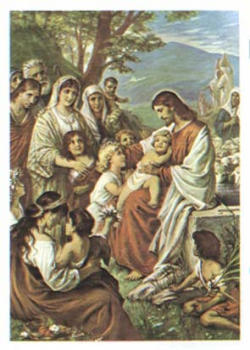
http://spiritlessons.com/Documents/Jesus_Pictures/Jesus_025.jpg
I often wonder about things?  How and why they happen.  Perhaps ‘cause and effect’.  For an atheist ‘suffering’ is just an accident of nature, which might or might not have a scientific or philosophical explanation, but it’s one of their evidences that God doesn’t exist.
Coming from a Christian perspective, we believe that things happen because either God wills them, or because mankind, going against the will of God, causes bad things to happen.   ‘Simples’ as the Meerkat says.
However, life isn’t that simple and good and bad things happen all of the time, which cause me to stop and think, either ‘how wonderful’ or more often ‘how awful’, and I ponder on how and why God allows natural disasters and suffering to persist in the world?
It appears that Suffering is the  symptom of man exercising his free will and sinning.  Sin is anethmae to God, who sent Jesus to rescue man from his sin through his death and resurrection.  Our continuing sin, contributes to continuing suffering and allows God’s work to be seen in the word?  We haven’t got a good bargain there then!
It seems that God allowed the creation of sin and suffering in the first place?  This is the paradox.   Cause and effect equal cause and effect in a never ending cycle, until God’s will is done.  And it will only be done, when Jesus comes again.
Looking for guidance I find:
Isaiah 55.8 tells us that God thinks and acts on a level different from ours. He sees things from a much broader overview. From our perspective, it’s as though we were putting together a jigsaw puzzle with many of the pieces missing. What part of the picture are we failing to see?[2] God has a plan!
Paul says that “I have been crucified with Christ” (Gal: 2.2) and “I complete what is lacking in Christ’s afflictions for the sake of His body, that is, the Church (Coll 1.24)  He really underlines it with : “For it has been granted to you that for the sake of Christ you should not only believe in him but also suffer for his sake” (Phil 1:29).  God’s plan in fruition!
Jesus himself points us towards suffering for his sake. ““I can of Myself do nothing. As I hear, I judge; and My judgment is righteous, because I do not seek My own will but the will of the Father who sent Me.”  (John 5:30)God’s will is being seen to be done!
This is all well and good, but when we are seeing so much death and destruction wrought around the world and in people’s lives – how can we reconcile ourselves to the fact the we seem predestined to suffering, with no control over how and why it happens, even if our freewill is used for the good, there are so many others where it isn’t. It is a hard a burden to bear?  It’s certainly not the bargain we signed up to, we had no choice in it, it was created for us.
Ah, We’re told that God’s plan includes suffering to allow God’s work to be visible in the world.   So, cause and effect is God’s way of helping us to obey the two greatest commandments (Mark 12:28-31).  Because these two commandments underpin all of the law given to us through scripture and the biblical stories of the Jews as the chosen people.
I read this commentary:[3]
Ÿ Evil and suffering are real – not illusions. They are ‘intrusions’ into the good world God originally made. The bible tells how when Jesus came to earth he stood outside the tomb of his best friend Lazarus and saw the bereaved sisters:   When Jesus saw her weeping, and the Jews who had come along with her also weeping, he was deeply moved in spirit and troubled. (John 11:33)  Literally he was ‘angry’ – death was seen by Jesus as a violent and horrible invasion into his Father’s world.
Ÿ  Ultimately, suffering is linked to our rebellion against our Maker. It is a reminder that the world we live in is ‘out of sorts’ with God and stands under judgment.  ‘Therefore, just as sin entered the world through one man, and death through sin, and in this way death came to all men, because all sinned–’ (Romans 5:12)
Ÿ  This does not mean that every ‘item’ of suffering is a direct punishment from God. This was a question the disciples asked of Jesus about a man born blind: ’Who sinned, this man or his parents?’ Jesus’ reply pointed them beyond the suffering to God’s rescuing purposes in himself – “Neither this man nor his parents sinned,” said Jesus, “but this happened so that the work of God might be displayed in his life.” (John 9:3)
Ÿ  Both man made suffering and ‘natural’ suffering should focus our minds on ultimate issues, causing us not so much to ask ‘Why doesn’t God do something about this?’ but “what is my response to this? How might I change?”

Finally, some enlightenment.  It’s not in fact God’s plan to allow suffering.  It’s not God’s plan to allow sin and death.   God’s plan was subverted by Man’s free will, and by the actions of Adam and Eve, tempted by the serpent, which caused original sin, caused the fall of man, caused mortal death and decay and caused sin and evil in the world.  If I change, perhaps others will change. If others change, we may get the ‘wave’ effect we see at large sporting events.  The stone cast in the pond, causing the ripples to spread wider and wider. God’s will coming to its true fruition.
Twitt

About bigbible

The #BigBible Project. Educating in the digital spaces, creating 'bigger Bible conversations' between 'digital disciples'. Ran the #bigread12.

Monday, 7 May 2012

Induction of Rev'd Lesley Crawley : 6 May 2012


Induction of Rev’d Lesley Crawley - St Mark’s Church, Upper Hale - Sunday 6 May 2012

St Mark's Church, Upper Hale


On Sunday 6th May 2012, I and my spouse Jen, were invited to attend the Induction of the Rev’d Lesley Crawley as an associate priest to her husband’s benefice at St Mark’s Church, Upper Hale, Nr Farnham in Hampshire. I had known Lesley, via the medium of the internet, her blog, via twitter and facebook for several years. I had participated with her blog, and she had in many ways, helped me to develop and to grow as a Christian, while also seeking to explore a vocation to ordained ministry.

We jumped at the chance to finally meet Lesley and her husband in person, and possibly to network with others attending the service.

The Induction service was conducted by The Bishop of Dorking, The Right Rev’d Ian Brackley. It included the commissioning of a new Ministry Team for St Mark’s and the Benefice.

We arrived, in true military fashion, early for the event. And were met and greeted by ‘Winston’ who explained what was happening. Another welcomer, directed us to Rev’d Lesley, who we met for the very first time. She made us welcome, but given it was a few moments before the service, we only had a brief conversation. We took our seats and almost immediately, Laura Sykes aka @layanglicana and her husband came and sat alongside us. After introductions, we prepared for the service.

St Mark’s is a mid-Victorian build church, with walls rendered externally with local stone. Internally, it has some really lovely wall murals and paintings particularly in the Chancel. It has been reordered in the recent past and is blessed with the addition of a parish centre, with modern facilities added onto the rear of the church.

The church was full to overflowing and the first hymn ‘Thine be the Glory’ played by a combination of Organ and music group, resounded to the rafters. I haven’t heard such singing in a parish church, outside of Christmas or Easter ever.

We moved into the service which was Common Worship, with appropriate adaptions for the induction and licensing of the ministry team. We both found it prayerful and joyful for those participating. The atmosphere was electric with anticipation and agape love was there in abundance. Bishop Ian delivered a warm sermon linked to the Gospel reading which prepared us for the induction and licensing.

Lesley’s induction and licensing was enlightening for both of us, who hadn’t seen one before. It was obvious that Lesley was happy and beaming as was Alan, her spouse and incumbent. It included the prayerful part and formal part of swearing of oaths, which highlights the place of the CofE as the Established Church with the Queen as Governor. It seemed incongruous in some way to mention the Book of Common Prayer, in a Common Worship service, but I rejoice that it retains an honoured place in this liturgy.

The rest of the service seemed to fly by. There were so many communicants, that it took some time. It was great to receive the Blood of Christ from Lesley herself, strangely, it seems just appropriate on the day. The Choir sang hymns alongside the communion, ‘Will you leave yourself behind, If I call your name’ which is used in our parish and I love it. The closing hymn was the upbeat worship song ‘All the tree’s in the fields will clap their hands’ which I have sung before, the second rendition greatly sped up, caught me out, but in a nice way.

After the service there was the opportunity to mingle with the parishioners and to share food and drink informally and of course to have a wider conversation with Lesley and her husband Alan. In the end, I and my spouse spoke to a number of different individuals, my spouse being quite good at the circulating thing, while I remained static and spoke with those around me. I ended up in an Ecumenical conversation with Rev’d Alan and the local RC Parish Priest, Fr Dave. It’s surprising how much we have in common on a person-to-person basis. This is when what divides us disappears and you see the local church for what it really is an can be. A partnership in the community in the name of Christ.

Sadly, we had to leave before the bun fight finished, but departed heartened by our visit, and grateful for our welcome, the fellowship of everyone we met and of course the friendship pouring forth from Lesley and Alan.

We came away refreshed and joyful. I came away affirmed that at local level, in a completely different place from my own comfort zone, the church is alive, well and flourishing. That’s the story that doesn’t make the news, or get into the national media. Quiet work and pastoral care locally, building the kingdom day by day, hour by hour with each other.


Thursday, 19 April 2012

The Sabbath #Bigread12 Blog Post


Easter Tuesday Mark 2.23-27 #BigRead12 with @minidvr

The Sabbath:
In this passage Jesus and his disciples are seen to be picking ears of corn [1]and eating them on the Sabbath. Something which those who hated them, criticised them for it being illegal. Jesus makes the point very clearly that David, who was God’s annointed, had entered the temple with his soldiers while on the run from Saul, and had eaten the ‘Bread of thePresence’, which even the priests were forbidden to eat.  Jesus is drawing our attention to his authority as the Son of God, who the rules of man should not be applied to.  His quoted text says it all ‘The sabbath was made for humankind, and not humankind for the sabbath; so the Son of Man is lord even of the sabbath.’
Genisis 2:1-3 describes how God made the seventh day Holy, as a memorial to his creation which was ‘good’ and rested on the seventh day.   We are commanded (as were the Jews) in Exodus 20:8 to remember the Sabbath day by keeping it holy.  But surely we should consider every day holy in the service of God, marking the Sabbath as a day of rest and worship of God.  Which seems to me to be my interpretation of God’s intention and the reason behind the commandment.
Pondering on this, I think back to my childhood in the UK in the 1950s.  In those days, Sunday was kept as the Sabbath, quite strictly.   For many working people, it was the only day that they got relief from work for the week.  Many attended worship in churches, shops were closed and only essential public services worked.  Even those who didn’t go to church took advantage of the Sabbath and pursued leisure activities and sport. Sunday was time for rest, family and prayer, not always in that order.   Public transport ran to a Sunday timetable, and pubs and entertainment establishments had very restricted hours.  If you lived in a remote community, Sunday was definitely not the day to have a mini-crisis to run out of milk, to break down.  Nothing would happen until Monday morning.  It was slightly different in more urban communitities, but even here things were closed and the Sabbath was observed to a great extent.
Now, some 60 years later, an enormous transformation has happened.  The Sabbath is only observed by those who practice a religious faith.  Sunday has been swallowed up in the busyness of life lived in a 24/7 economy.  This way of life is common to both rural and urban communities.  Shops are free to open for restricted, but fairly long hours.  Pubs and entertainment establishments can operate 24 hours in some places and secular work is a norm.   Even those who observe the Sabbath, are expected to work if thier employer requires it, or risk losing their job. It seems that society has bowed down the mammon and has allowed secular past times and activities to become more important than those who observe the Sabbath.
I remember in the last 2 years of my working life, I became a Christian.  I had quite happily worked innumerable Sabbath’s, but something had changed.  Jesus had become my Saviour and I had a new set of rules to live out and to live by.  All of a sudden, Sunday became precious.  It was the time that I could dedicate to worship, family and leisure.   In that last two years, I only worked on 2 Sundays, where it could not be avoided, but only if a dispensation was made that I could have time off to attend worship.  Conflict could have ensued, others who had to work, could have said that I was given preferential treatment.  But somehow God’s grace didn’t allow this to happen.  Those who I worked with having been surprised by my conversion, graciously allowed me the time and space to grow and to develop as a Christian and to practice my faith, which I had proclaimed openly in the work place.
I wonder how often that would happen in other work places?  I’m not sure, because I continually read of employers not being ‘faith’ friendly and that reasonable accommodation is not being made for people of any faith to practice their religion freely and in accordance with their conscience.
I don’t blame those employers or people who refuse to contemplate that Christianity or any other faith should be a special case,  they after all, are as entitled to their views as we are in ours.  But it just seems that something has been lost in the transformation and change of the last 50 years or so. That sense of graciousness,  of consideration and compassion for others, displayed by my work colleagues towards me, has been lost in many places. It has been subborned to the busyness of life, of the individual and their rights and the pursuit of wealth and personal happiness, not matter what the cost to our souls.
I wonder if it will ever be regained without a wholesale infusion of the Holy Spirit into people’s lives. I pray for it daily.